0%

Choosing the best colored contact lens manufacturer in 2026 is not simply a matter of finding the brightest shades or lowest unit price. Buyers should examine how a company manages lens materials, color consistency, oxygen transmission, packaging, and quality checks across production runs. Small differences matter: a sample may look vivid under studio lights but appear softer beside a window.

This guide compares manufacturers through practical, verifiable criteria. It considers product range, customization options, documented quality systems, production capacity, communication, and after-sales support. Where available, readers should review current certificates, test reports, and product documentation directly, since standards and approvals vary by market. A polished website is not proof of dependable manufacturing. Ask for samples. Check the details.

The right partner also depends on the intended customer, order volume, and sales channel. A boutique brand may value flexible designs and responsive sampling, while a larger distributor may prioritize stable lead times and repeatable batches. No single ranking can fit every business. Some information may remain difficult to verify before a factory audit, and that uncertainty deserves attention rather than a confident guess. The sections ahead offer a balanced way to compare options, identify useful questions, and avoid choosing on appearance alone. Comfort and eye health ultimately depend on appropriate products and professional guidance, not marketing claims.
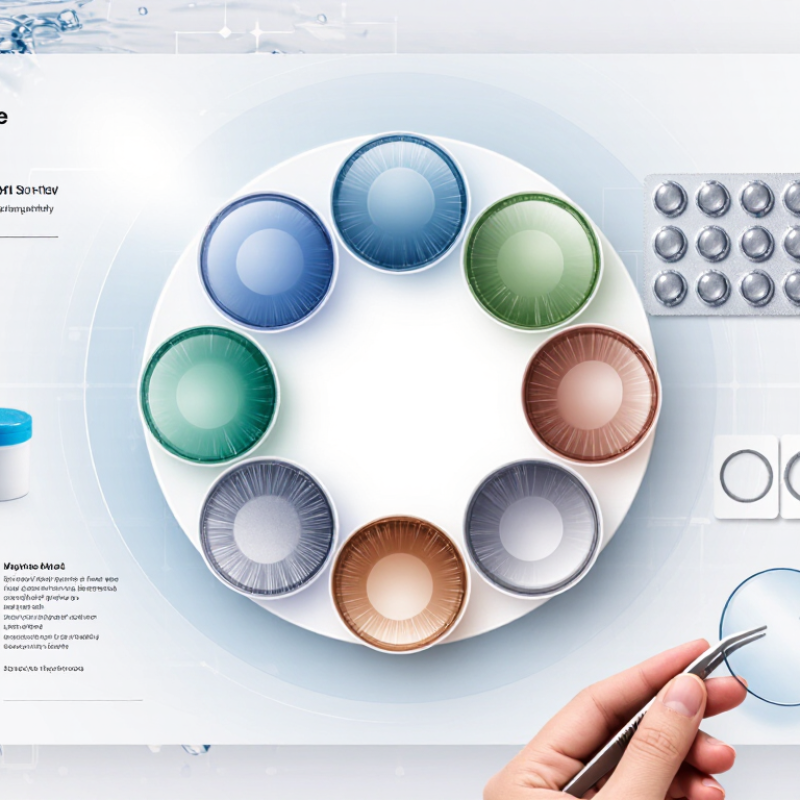
Which Colored Contact Lens Manufacturer Is Best in 2026?

Define Manufacturer Quality Through ISO 13485 and ISO 18369 Compliance

A colored contact lens is both a visual product and a medical device. Its quality depends on more than an attractive color sample. ISO 13485 provides a framework for a manufacturer’s quality management system, including documented processes, risk controls, and traceable production records. Ask whether the certificate covers the actual manufacturing site and product scope. A certificate alone is not proof of every lens’s quality.

ISO 18369 addresses contact lens terminology, measurements, and related technical requirements. In practice, a manufacturer should be able to explain how it checks lens dimensions, optical power, and material properties. Ask how color consistency is monitored between production lots, too. A useful record might connect a specific batch number to inspection results and packaging checks. Details matter.

Look for clear answers, not just polished certificates. Can staff explain what happens when a measurement falls outside limits? Are test methods documented and records available for review? These questions reveal how standards work on the factory floor. Still, paperwork has limits. It cannot replace independent evaluation, and a compliant system does not mean every product is perfect. Standards are a strong filter, not a shortcut to certainty.

Check U.S. FDA Status: Decorative Lenses Are Class II Prescription Devices

Choosing the best colored-contact-lens manufacturer in 2026 starts with a regulatory check, not a shade chart. In the United States, decorative contact lenses are Class II medical devices, even when they do not correct vision. The FDA requires a prescription for contact lenses; color does not make them ordinary cosmetic accessories. Check the exact lens model in FDA device records and look for applicable 510(k) clearance. “FDA registered” alone does not mean a product is cleared or endorsed.

Safety records matter. The CDC’s 2015 MMWR report estimated that contact lens-related eye infections caused nearly one million outpatient and emergency visits annually, with about $175 million in direct medical costs. That figure covers contact lens infections broadly, not colored lenses alone. Still, it shows why fit and hygiene deserve attention. Fit matters. Ask an eye-care professional to assess the specific lens, then compare the manufacturer’s labeling, material details, and replacement schedule. A polished package cannot confirm a safe fit. Nor does regulatory clearance guarantee that a lens will suit every eye.

Which Colored Contact Lens Manufacturer Is Best in 2026? — Check U.S. FDA Status: Decorative Lenses Are Class II Prescription Devices

Evaluation Dimension Verified U.S. Regulatory Fact What to Check Before Buying How It Affects a Manufacturer Comparison
Device classification Contact lenses, including lenses worn only to change eye color, are medical devices. Contact lenses are generally Class II devices under U.S. FDA regulations. Look for device-specific FDA marketing authorization information, such as a 510(k) clearance or, where applicable, a PMA approval. A Class II classification alone does not show that a particular product is authorized for sale.
Prescription requirement Decorative and non-corrective contact lenses require a valid prescription in the United States, just like vision-correcting contact lenses. Confirm that the seller requires a prescription and that the prescription matches the lens being supplied. A seller offering cosmetic lenses without a prescription is a significant compliance and safety warning.
Product-specific authorization FDA authorization applies to specific devices and indications; it should not be assumed to cover every product made by a manufacturer. Match the exact product or device information to the FDA record and check that its intended use includes the lens type being sold. Compare products individually rather than relying on a general claim that a company is “FDA approved.”
Clearance versus approval A 510(k) clearance and a PMA approval are different regulatory pathways. “FDA registered” or “FDA listed” does not mean that FDA has approved or cleared a product. Check the exact regulatory term and the corresponding FDA record; be cautious of vague “FDA certified” claims. Specific, verifiable authorization is more informative than a broad marketing statement.
Prescription and labeling details Contact lenses are prescription devices and should be dispensed according to the patient’s prescription and the product’s labeling. Verify lens parameters, intended wearing schedule, replacement schedule, care instructions, and the product identity on the packaging. Clear, product-specific labeling supports safer use and helps distinguish legitimate products from unclear listings.
Eye-care professional involvement Contact lenses can cause eye injury or infection when improperly fitted, worn, or cared for. FDA advises consumers to obtain lenses through an eye-care professional. Have an eye-care professional fit the lenses and provide instructions, even when the lenses have no vision-correction power. A responsible purchasing process includes prescription verification and professional fitting—not just an online checkout.
Overall selection standard FDA status is an important safety and compliance check, but it does not by itself establish that one manufacturer is “best” for every wearer. Prioritize verifiable product authorization, prescription-only sales, appropriate fitting, clear labeling, and professional guidance. Choose the specific lens that meets these checks and is suitable for your eyes, rather than relying on brand claims alone.

Important: This table provides general U.S. regulatory information, not medical advice. Confirm current product-specific records and consult an eye-care professional before wearing colored contact lenses.

Compare Oxygen Transmissibility Against the 24.1 Dk/t Daily-Wear Benchmark

In 2026, the best colored contact lens manufacturer should offer more than vivid iris patterns. For daily wear, compare oxygen transmissibility, or Dk/t, rather than material Dk alone. Holden and Mertz’s 1984 clinical analysis reported 24.1 × 10⁻⁹ as the minimum Dk/t associated with limiting corneal swelling during daily wear. Treat it as a benchmark, not a safety guarantee. Real eyes vary.

Ask for measured Dk/t at the lens’s actual prescription and center thickness; a material’s headline Dk cannot show finished-lens performance. ISO 18369-4:2017 describes methods for measuring contact-lens material properties, supporting comparisons based on documented results. Pigment placement, added layers, and prescription strength can affect a lens’s thickness and oxygen delivery. Small details matter. If a manufacturer gives no test method, units, or power-specific values, comparison is weak. I would not rank a lens by packaging or one laboratory number alone. Have an eye-care professional assess fit, and seek advice if your eyes become red, painful, or unusually dry.

Which Colored Contact Lens Manufacturer Is Best in 2026? Compare Oxygen Transmissibility Against the 24.1 Dk/t Daily-Wear Benchmark

These historical benchmarks are reference points, not guarantees of safety. The chart does not compare manufacturers: a colored lens’s Dk/t depends on its material and thickness, so verify product-specific measurements rather than inferring performance from a brand or lens type.

Source: Holden BA and Mertz GW, “Critical oxygen levels to avoid corneal edema for daily and extended wear contact lenses,” Investigative Ophthalmology & Visual Science, 1984. Dk/t values shown in 10−9 (cm/sec)·(mL O2/(mL·mmHg)).

Evaluate Color Design, Water Content, Replacement Cycles, and Clinical Evidence

Which Colored Contact Lens Manufacturer Is Best in 2026?

Choosing a colored contact lens manufacturer takes more than comparing attractive shades. Color design should look believable in daylight, not only in edited product photos.

Check whether the printed pattern leaves the pupil area clear and whether several eye colors are shown. Ask how the lens feels and looks on different eyes.

Water content matters, but it does not predict comfort by itself. Material, oxygen transmission, fit, and wearing time also count. Fit matters too.

A manufacturer's replacement schedule should be easy to find and follow. Daily, biweekly, and monthly lenses are not interchangeable; never extend a lens’s stated use period.

Small details matter. Compare clinical evidence, not just marketing claims: look for clear information about testing, lens parameters, manufacturing quality, and reported safety outcomes.

Independent studies and transparent documentation are more useful than vague phrases such as “clinically proven.” A product page is not proof.

An eye-care professional can assess fit and eye health before use, especially for first-time wearers. I would treat missing test details as a reason to pause, even when the color looks perfect.

Rank 2026 Manufacturers by Audited Quality, Traceability, and Recall Records

A credible 2026 ranking of colored contact lens manufacturers should begin with evidence, not packaging or popularity. Give the greatest weight to independent quality audits, documented production controls, and corrective-action records. Audits should cover the manufacturing site, not merely a corporate office. Look for dated findings, clear scope, and proof that problems were addressed. Paperwork alone is not proof.

Traceability deserves its own score. A strong system can link a finished lens to its production lot, materials, inspection results, and distribution records. Test it with a sample lot. Can the records identify where it went? If not, the score should fall. Recall history matters too, but a recall does not automatically signal poor quality. Review its cause, response speed, affected lots, and evidence that corrective steps worked.

A practical ranking could assign 40 percent to audited quality, 35 percent to traceability, and 25 percent to recall handling. Use recent, verifiable records and apply the same criteria to every manufacturer. Missing documents should count as uncertainty, not as a clean record. That distinction is easy to miss. Public data can also be incomplete, so any ranking should state its limits rather than imply certainty.

FAQS

What does ISO 13485 indicate about a contact lens manufacturer?

It describes a quality management system with documented processes, risk controls, and production records. Check that its scope covers the actual manufacturing site and products.

What does ISO 18369 help assess?

It covers contact lens terminology, measurements, and related technical requirements. Ask how the manufacturer checks lens dimensions, optical power, material properties, and color consistency.

Does a certificate prove every lens is high quality?

No. Certificates and paperwork are useful filters, but they cannot confirm every product is perfect. Independent evaluation still matters.

How can I judge whether a colored lens design may look natural?

Check examples in daylight and on different eye colors. Look for a pattern that keeps the pupil area clear. Edited photos can mislead.

Does higher water content always mean better comfort?

No. Comfort also depends on material, oxygen transmission, fit, and wearing time. Fit matters.

Can daily, biweekly, and monthly lenses be used on the same schedule?

No. Follow each lens’s stated replacement period, and do not extend it. Small details matter.

What clinical evidence should I look for?

Seek specific testing information, lens parameters, manufacturing quality details, and reported safety outcomes. Vague claims are not enough.

What makes a manufacturer ranking more credible?

Use the same criteria for every manufacturer: independent audits, traceable production records, and recall handling. Missing documents mean uncertainty, not a clean record.

What should traceability records connect?

They should link a finished lens to its production lot, materials, inspection results, and distribution records. Try checking a sample lot.

Does a recall automatically mean a manufacturer has poor quality?

No. Review the cause, response speed, affected lots, and whether corrective steps worked. Public data may still be incomplete.

Conclusion

Choosing the best colored contact lens manufacturer in 2026 means looking beyond appearance and price. A reliable assessment starts with quality systems and evidence of compliance with ISO 13485 and relevant ISO 18369 requirements. In the United States, decorative lenses are Class II prescription devices, so a manufacturer’s FDA status and documentation should be checked carefully rather than inferred from marketing claims.

Compare oxygen transmissibility with the 24.1 Dk/t daily-wear benchmark, while also considering color design, water content, replacement schedule, and the clinical evidence supporting each lens. A balanced review should examine audited quality processes, production traceability, and recall records to understand how consistently a manufacturer manages safety and product issues. No single feature determines the best choice: the strongest evaluation weighs documented quality, suitable lens characteristics, and transparent evidence together. A qualified eye-care professional can help determine whether a particular lens is appropriate for an individual wearer.

Oliver

Oliver

Oliver is a professional marketing specialist with a strong understanding of the company’s products, their practical applications, and the needs of the customers they serve. He regularly contributes expert articles to the company website, offering clear, useful guidance and thoughtful perspectives......